The modern workplace has been evolving at an unprecedented pace. Since 2020, organizations have navigated remote-first models, hybrid transitions, and renewed return-to-office mandates with many companies now operating all three simultaneously.
This shift has transformed how employees work, where they work, and what they need to stay healthy and productive. And with that transformation comes new ergonomic challenges and remarkable opportunities for innovation.
Below, we break down the biggest office trends shaping 2026 and what they mean for organizations looking to create healthier, more adaptive workplaces.
The New Workplace Reality: Hybrid Is the Majority
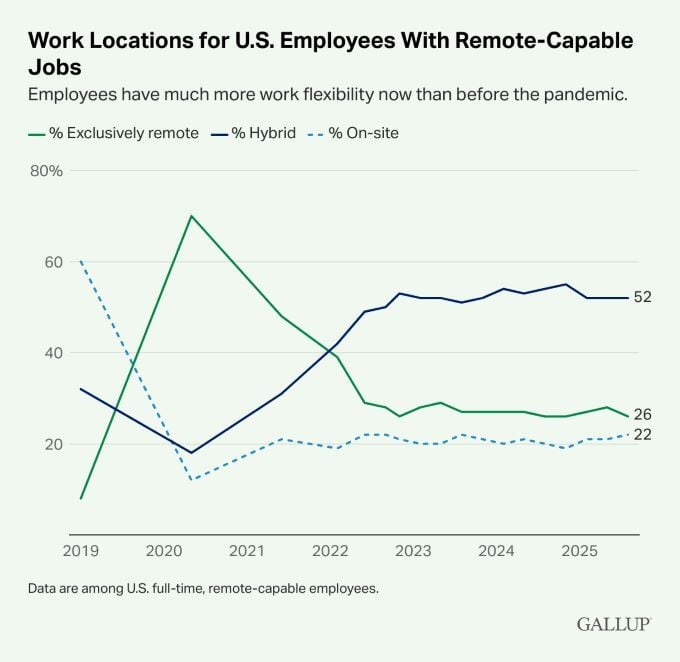
Recent employee and employer data paint a very clear picture. According to Gallup’s 2025 survey of remote-capable jobs, 52% of employees with remote-capable jobs work in a hybrid model, 26% are fully remote, and only 22% are entirely on-site. Most employees now move between multiple workstations (home, office, shared spaces) and each setup has different chairs, surfaces, and technology.
This variability is one of the largest drivers of discomfort today. At the same time, it presents a major opportunity for organizations to rethink ergonomics with a more modern, flexible approach.
Employers feel the shift too. Robert Half’s 2025 Workforce Survey shows that 88% of companies now offer hybrid work in some capacity, and a quarter offer it to all employees. The flexibility hybrid work offerings provide have become a talent strategy for businesses and an expectation for potential employees.
The Counter-Trend: A Push Back to the Office
While hybrid work is dominant, several influential employers, such as Amazon, JPMorgan, Dell, and Kroger, are pulling back on remote flexibility and requiring employees to return onsite more regularly.
Their decisions are driven by several factors:
- A push to rebuild culture and collaboration
- Leadership concerns around productivity and visibility
- Communication challenges across distributed teams
- The financial weight of underused real estate
But returning to the office doesn’t automatically improve ergonomics. In some cases, it creates new risks. Many workers have spent years fine-tuning their home setups and investing in ergonomic office equipment for their homes like standing desks and adjustable chairs. Walking back into a legacy workstation with limited adjustability can lead to frustration and discomfort almost immediately.
As organizations accelerate return-to-office efforts, they face a critical question: Are their physical office spaces ready to support today’s workforce?

2026: A Moment of Risk and Opportunity
As thousands of employees transition between hybrid work environments or go back into offices full-time, the ergonomic landscape is shifting fast.
Three major risks are emerging now:
- Outdated office setups
Many workplaces still rely on fixed-height desks, basic chairs, and static layouts that don’t match the needs of modern knowledge work.
- Loss of customization
Home offices allowed employees to tailor their setups to their bodies. Removing that control often increases discomfort.
- Lack of consistency between workstations
Moving between different desk heights, monitor positions, or chair styles can create strain over time.
But this moment presents an opportunity for employers to keep and acquire talent. Companies can modernize their work environments, refresh ergonomic standards, and introduce more flexible layout strategies to build spaces designed for how people work now.
The Four Office & Ergonomic Trends Defining 2026
1. Scalable Personalization
The need for individualized support is growing, but traditional one-to-one ergonomic assessments can’t keep up with distributed workforces. That’s why organizations are adopting:
- Digital ergonomic self-assessments
- Virtual ergonomic coaching
- Guided self-correction tools
- Data integration with HR and safety software
These tools educate employees, reduce discomfort, and help organizations see patterns (like high-risk departments or common workstation issues) across entire populations.
2. Building Internal Ergonomic Capability
With HR, safety, and facilities teams stretched thin, organizations need equipment and professionals who can support ergonomics day-to-day.
Four key roles are emerging:
- Ergonomic champions: Employees trained to spot when something isn’t quite right and who can work with ergo teams.
- Managers with ergonomic awareness: Able to identify ergonomic issues and guide employees through simple adjustments.
- Self-sufficient employees: Workers who maintain consistent setups across locations and use checks to self-correct.
- Specialists on demand: Experts who handle complex cases and guide strategy.
The goal is to distribute knowledge so problems are caught early with backup on standby for those cases that can’t be handled with the simple solutions.
3. Hybrid-Ready Work Design
Hybrid-ready defines itself by consistent, functional setups across all places an employee works.
The biggest developments include:
- Duplicated or portable equipment for home and office
- Plug-and-play docking stations and USB hubs
- Flexible, easy-to-adjust chairs and desks
- Alignment of workstation dimensions across environments
When workstations “feel” the same, the body doesn’t need to constantly readjust—and employees experience far less discomfort.
4. Smarter Technology and Predictive Ergonomics
AI and data analytics are transforming how organizations identify and address risk.
Key advancements include:
- AI posture tracking and wearable sensors
- Computer vision tools that detect posture patterns without ergonomists onsite
- Ergonomic self-assessment software to reach remote workforce with ergonomic support
- Workforce discomfort dashboards for trend analysis
- Predictive modeling that identifies risk before injuries occur
- AI chatbots that answer ergonomic questions instantly and anonymously
Technology helps expand access to ergonomic expertise. Helping companies shift from reactive fixes to proactive prevention can be done at scale with the right technology solutions.
The Strategic Value of Ergonomics in 2026
Perhaps the biggest shift of all is how organizations view ergonomics. By shifting the view of ergonomics away from simple compliance, companies have expanded their view to see the actual business value behind ergonomics. A well-maintained workplace has:
- Talent attraction and retention
- Productivity and focus
- Hybrid workforce equity
- Wellbeing and mental health
- Real estate optimization
- Long-term cost savings
As work environments become more complex, organizations that invest in ergonomic support will see measurable benefits in performance, culture, and employee satisfaction.
Want more on this topic?
This article has been adapted from a 60-minute Briotix Health webinar on the same topic. Watch the webinar on-demand here.

