Ergonomics
2023 Top Workplace Safety Trends
Briotix Health experts discuss the top workplace safety and ergonomic trends to consider for your work-related injury prevention programs in 2023.
Explore the effects of behavioral health on injury risks and how integrating total worker health into your safety programs improves business outcomes.
May is Mental Health Awareness Month, and it serves as an important reminder that employee wellbeing extends far beyond physical health alone. Last week, Briotix Health behavioral health experts presented a webinar highlighting how employers today can improve workplace injury prevention and it starts with one thing: recognizing that behavioral health and workplace safety are deeply connected. Read on for an overview of the webinar with additional input from our speakers about behavioral health and injury prevention.
Our Experts:
For decades, workplace safety programs focused almost entirely on physical hazards, ergonomics, equipment, and injury response. While those areas remain essential, employers are increasingly understanding that mental health can significantly influence workplace safety outcomes, productivity, employee retention, and return-to-work success.
Today, organizations are beginning to challenge traditional assumptions and take a more comprehensive approach to injury prevention by addressing both physical and behavioral health together.

One longstanding assumption in many workplaces is that employee mental health should not be discussed or addressed by employers. However, the growing prevalence of mental health challenges makes that approach unrealistic and ignores the real impact of mental health that has always existed in the workplace.
A national survey found that approximately 60 million American adults were living with a diagnosable mental, emotional, or behavioral disorder. That translates to millions of employees navigating mental health challenges while still trying to perform safely and effectively at work.
Key Takeaways
Employers are beginning to recognize that supporting behavioral health is not only beneficial for employees, but also important for operational performance and workforce stability.
Many organizations already offer behavioral health resources, but simply having benefits available does not guarantee employees will use them.
Communication remains one of the largest barriers. Employees may not fully understand what services are available, how to access them, or whether they can use them confidentially. Barriers can look like:
These barriers can delay care and prevent employees from getting support before challenges begin affecting job performance or workplace safety.
Historically, workplace injury research focused on mental health after an injury occurred. However, newer research suggests behavioral health concerns may increase injury risk before an incident ever happens.
Several studies have identified a connection between depressive symptoms, mental health treatment, and increased workplace injury risk. A National Occupational Injury Research Symposium article in 2018 suggested that mental health can be a precursor of occupational injury as well as a consequence.
Reflecting on the growing body of research pointing to mental health impacts on safety, Kevin Robertson LMFT, CEAP said, “It starts to make us think about which came first, right, ‘the chicken or the egg’. Was the mental health need there prior to injury? Did it impact the injury? Or was it a consequence of the injury? And I think this is one of those scenarios where both can potentially be true. But certainly, from an injury prevention standpoint, we want to make sure that we’re looking at things like mental health, psychosocial stressors, [and] what’s going on with this individual… so we can make sure that they are safe and focused when they’re in the workplace”.
Behavioral health challenges can directly affect an employee’s ability to work safely. Stress, burnout, anxiety, and mental exhaustion can reduce attention span and impair decision-making.
“I think one of the really important pieces here is to make sure that we understand that behavioral health isn't just a diagnosable mental health disorder. It can be extreme stress. It can be someone on the verge of burnout. Someone who just experienced loss or is maybe going through a divorce, for example. Those are all important pieces that impact our ability to perform at a high level and reduce injury,” said Robertson.
In safety-sensitive environments, even small lapses in concentration can increase the risk of incidents involving machinery, slips and falls, or operational errors.
When organizations treat behavioral health as a core component of their safety strategy, they create an environment where teams are better equipped to stay focused, aware, and safe.
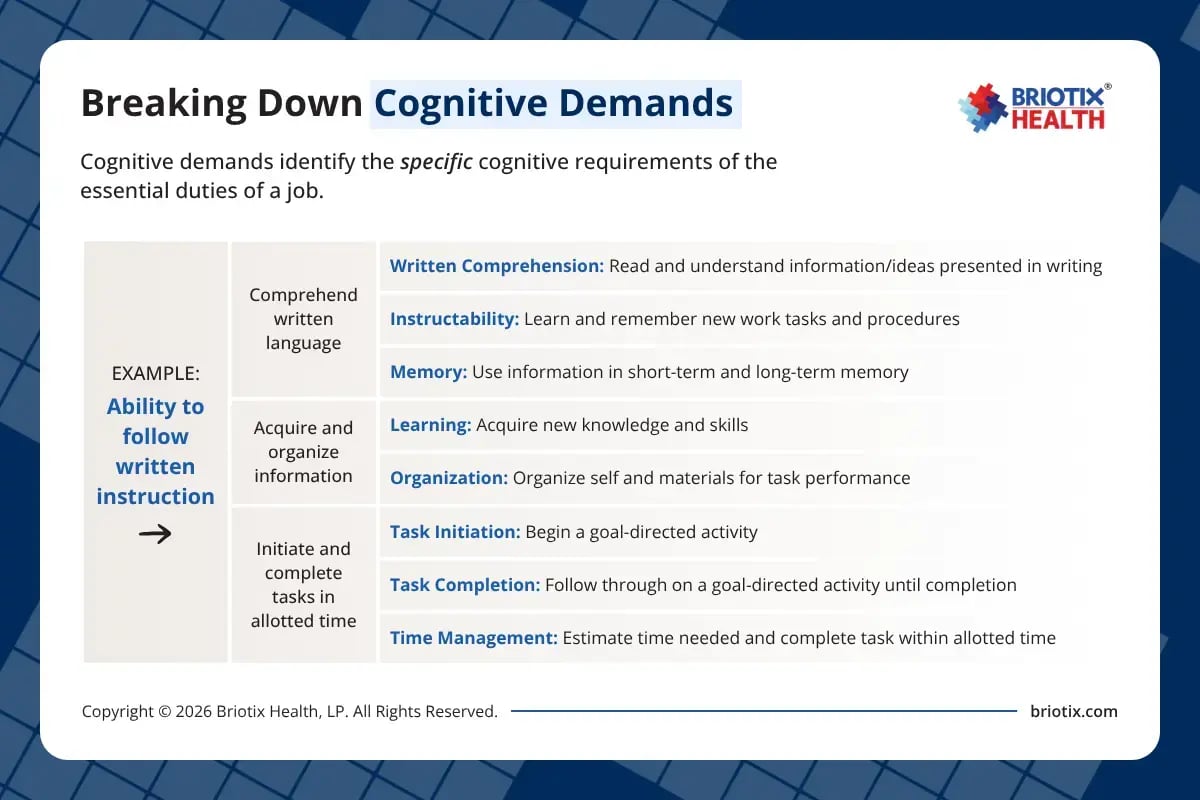
Understanding how behavioral health affects safety is only part of the picture. To effectively address these risks, organizations must look beyond physical hazards and consider the cognitive demands placed on employees.
Cognitive demands assessments examine the mental requirements associated with essential job tasks, including concentration, memory, time pressure, social interactions, and workplace stressors.
Benefits of Cognitive Demands Evaluations
By understanding both physical and cognitive job demands, employers can build safer and more supportive work environments.
As organizations gain a clearer understanding of both behavioral health risks and cognitive job demands, the next step is applying that insight to support employees in the workplace, especially during periods of recovery or transition.
Effective accommodations and return-to-work (RTW) strategies help employees safely perform essential job functions while addressing temporary or ongoing limitations. This requires collaboration between employees, employers, and healthcare providers, grounded in a clear understanding of job demands and individual capacity.
An important consideration, said Crystal McWilliams, MSW, LCSW, CPDM, is that “many individuals living with behavioral health or neurocognitive conditions have experienced years of being misunderstood or mislabeled as lazy, unmotivated, careless, or not trying hard enough. Over time, these experiences can create significant shame and self-doubt which may become barriers for asking for help in the workplace... When employers approach concerns collaboratively rather than punitively, employees are often more willing to engage in support strategies, communicate openly, and participate in solutions that improve workplace functioning. Employees are more likely to succeed when support replaces shame”.

Onsite safety professionals, like industrial athletic trainers, are a valuable resource for employee wellness strategies. In addition to supporting employees’ physical health, onsite providers can help identify early behavioral health concerns, reinforce safe work practices, and complement return-to-work efforts.
When your behavioral health team has members who understand both sides of the equation, the physical and the mental, your employees will benefit greatly.
When aligned with cognitive and physical job demands, return-to-work job coaching can support successful workplace reintegration while helping employees maintain job function and confidence.
The intersection of behavioral health and workplace safety is becoming increasingly important across every industry. Mental health challenges can influence focus, decision-making, productivity, injury risk, and overall employee wellbeing.
Organizations that proactively support behavioral health as part of their safety strategy may strengthen injury prevention efforts, improve retention, and create healthier workplace cultures overall.
If you are looking for these methods in action, check out our recent webinar, where our experts review and break down a real example of these methods in action for an employee struggling with behavioral health challenges.
As Mental Health Awareness Month leads us into National Safety Month, employers have an opportunity to rethink traditional safety programs and recognize that workplace safety includes both physical and mental wellbeing.
Looking to go deeper into this topic? Watch the full 50-minute webinar by filling out the form below.
Briotix Health experts discuss the top workplace safety and ergonomic trends to consider for your work-related injury prevention programs in 2023.
Briotix Health experts discuss the top ergonomic trends for office and hybrid workers in 2023.
Explore what every HR manager, CEO, and Safety Manager should be asking for better on-site injury prevention and a healthier, more productive...